Tunable processing
A perceptual mechanism involved in the pop-out effect, the phenomenon in which a particular visual pattern readily catches the eye. For example, the backward slash mixed among the forward slashes below is easy to spot.
/ / / / / / / / / /
/ / / / / / / / / /
/ / / \ / / / / / /
/ / / / / / / / / /
Terminology
Psychologist Anne Treisman, who published the first systematic study of the pop-out effect, called it “preattentive processing.”1
But the study explicitly told participants in advance which pattern to look for. Considering that a pattern may not stand out on its own without such advance notice (see: inattentional blindness), “preattentive” is not an appropriate term. For this reason, Colin Ware proposed “tunable processing” as an alternative. We can, to some extent, tune which patterns stand out by adjusting where we direct our attention:
A better term would be tunable, to indicate those visual properties that can be used in the planning of the next eye movement. —p29, Visual thinking for design
Visual features
The following are examples of visual features that produce the pop-out effect.
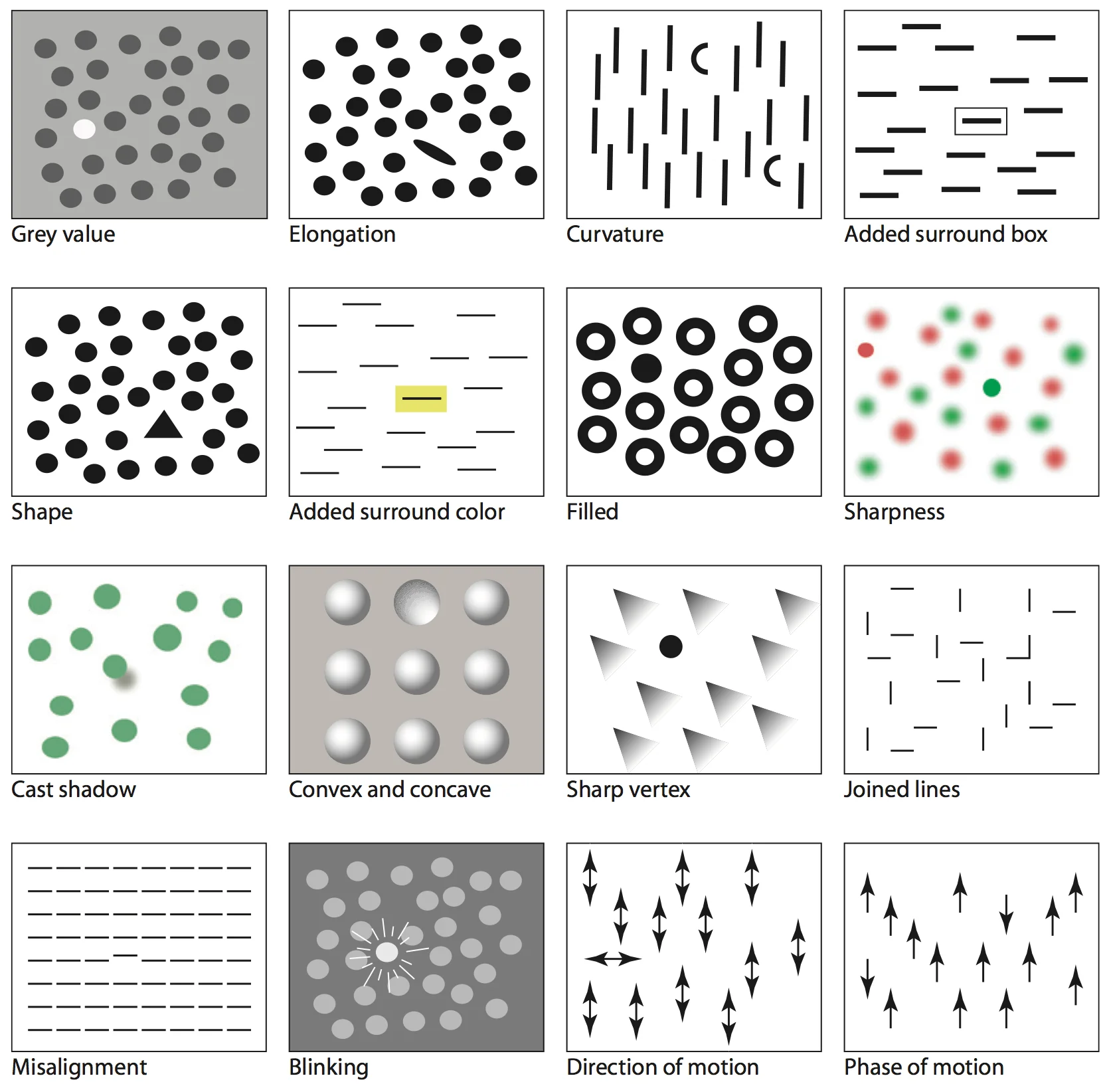
Pop-out can be produced using visual features primarily recognized in the primary visual cortex, such as a striking color, a different orientation or size, shadows, and focus. I say “primarily” because some features known not to be processed entirely in V1, such as motion, can also produce pop-out effects.
See also
- Feedback from V1 to LGN: There are far more reverse signals from V1 → LGN than signals from the LGN → V1. This may be related to why attention can tune the pop-out effect.